Case study II
hxgon
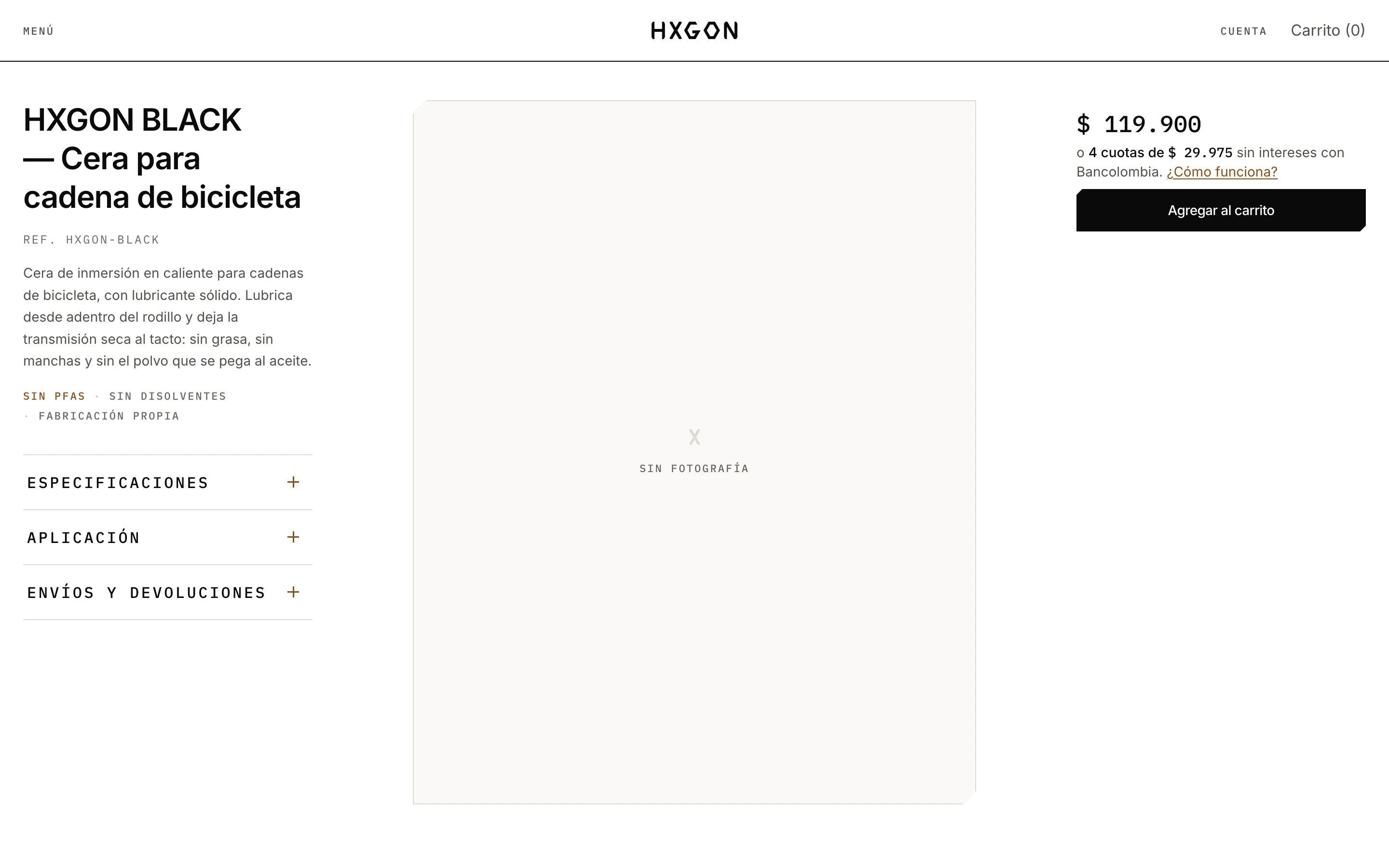
hxgon is my own online store for hot wax for bicycle chains, shipping across Colombia. I built it from scratch instead of renting a platform like Shopify, so every future sale stays mine, with no monthly fee and no platform commission.
- Role
- Founder and sole developer
- Year
- 2026
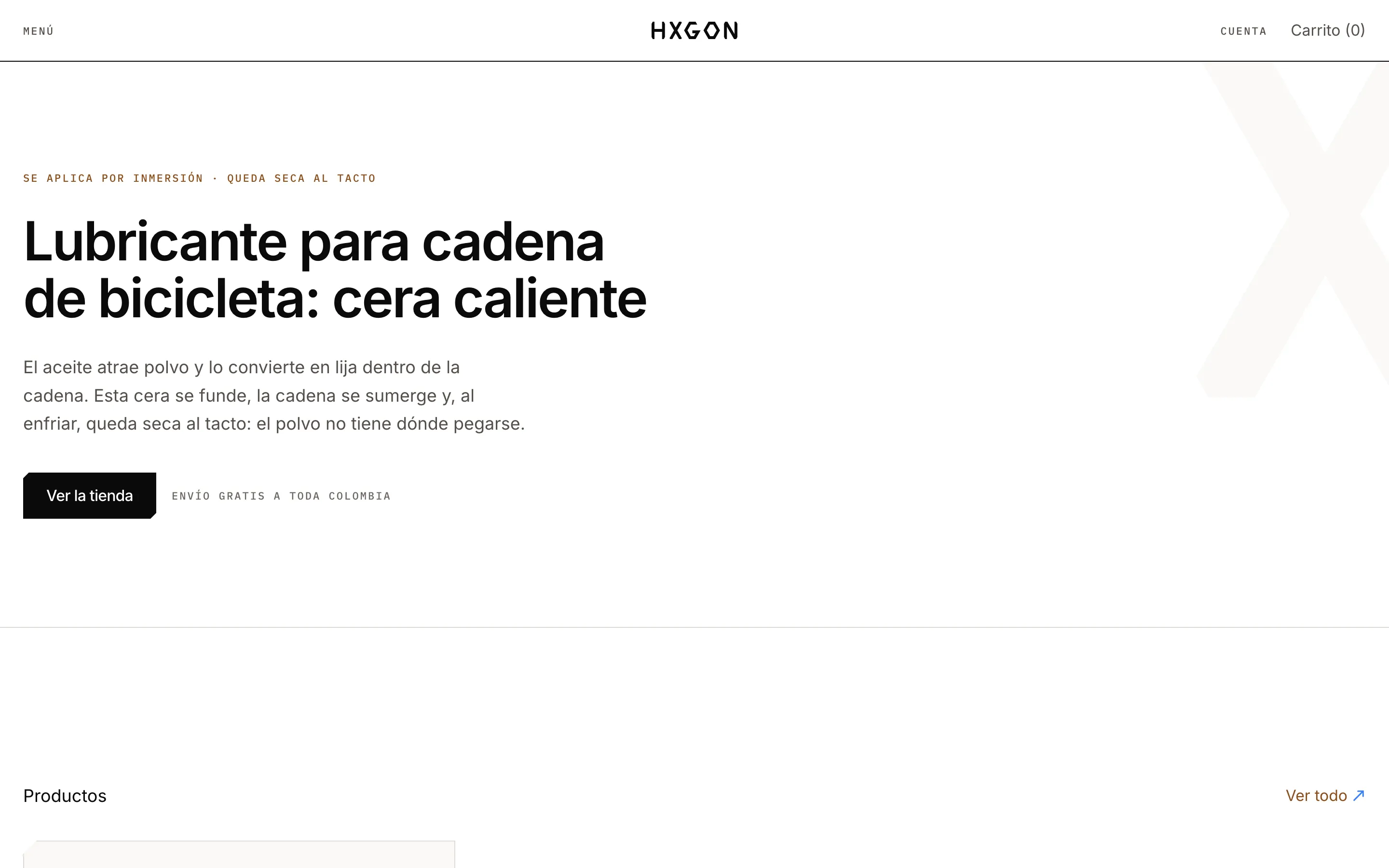
Live since September 2026 and ready to sell, with payments by card, Nequi and PSE tested with real money, on a server that costs under ten dollars a month.
The problem
I wanted to sell one product, a chain wax that keeps a bicycle drivetrain clean and dry, without handing a share of every sale to a platform. Shopify and its peers charge a monthly fee and a cut, and while a small brand is still finding out whether people will buy, those costs eat the margin before there is one.
The store also had to speak Colombian: prices in pesos without decimals, payment methods people actually use here, and shipping to every corner of the country.
The solution
A store I own end to end. The catalogue, cart and orders run on Medusa, an open-source commerce engine, and the shop window is a Next.js site written for one job: explaining why wax beats oil and getting the chain into the cart.
Payments go through Wompi, from Bancolombia, so customers can pay with a card, with Nequi or by bank transfer through PSE. Every order confirmation, shipping notice and receipt is sent automatically by email.
I built it locally first and only rented a server once the store was ready to sell. Everything runs on one small machine, behind Cloudflare.
The outcome
- The store has been live since 14 September 2026, ready to ship anywhere in Colombia.
- Card, Nequi and PSE payments were tested end to end with a real transaction.
- No monthly platform fee and no commission per sale, only the payment processor’s.
- Hosting costs under ten dollars a month.
- When the store went down for a few minutes, the logs showed it was a reload loop in the product page, not the server. It was found and fixed in a day.
Technical notes
The backend is Medusa v2 with PostgreSQL and Redis, in Docker, behind Caddy. Wompi is integrated as a custom payment provider: the integrity signature is computed only on the server, webhooks are verified by checksum and made idempotent in Redis, so a resent event never creates a second order. Money is stored as whole pesos and converted to cents in exactly one place. Each architectural decision is written down as an ADR.